Ceiling repair after water damage
Have the leak fixed first, let the ceiling dry and measure the moisture before anything else. If the plaster is still hard, the stain gets a stain-blocking primer and the whole ceiling is repainted; if it is soft, bulging or loose, it has to come off and be replastered. At Spetterloos that costs from €300 for a small ceiling to about €900 to €1,260 for 30 m² replastered and spray painted, including 9% VAT.
Rather not work it out yourself? Ask for a free quote, in English, with covering and cleaning up included.
Get a free quoteUpdated on · Edited by: Samir El Ouariachi, painter and plasterer
First the leak, then the ceiling
Repairing a ceiling only makes sense once the leak is properly fixed. If water keeps coming in, or a pipe drips now and then, the ring will be back within a few weeks. So have the cause sorted first by a plumber or roofer, or by your landlord or owners' association (VvE) if it is their responsibility.
Take photos of the damage before anything is removed. According to the Dutch consumer association (Consumentenbond), most insurers pay nothing or less if you repair the damage straight away yourself. Report it to your insurer first.
- Get the leak fixed and note the cause
- Photograph the ceiling, walls and belongings
- Report the damage to your insurer, or to your landlord if you rent
- Let the ceiling dry and have the moisture measured
- Only then repair and finish
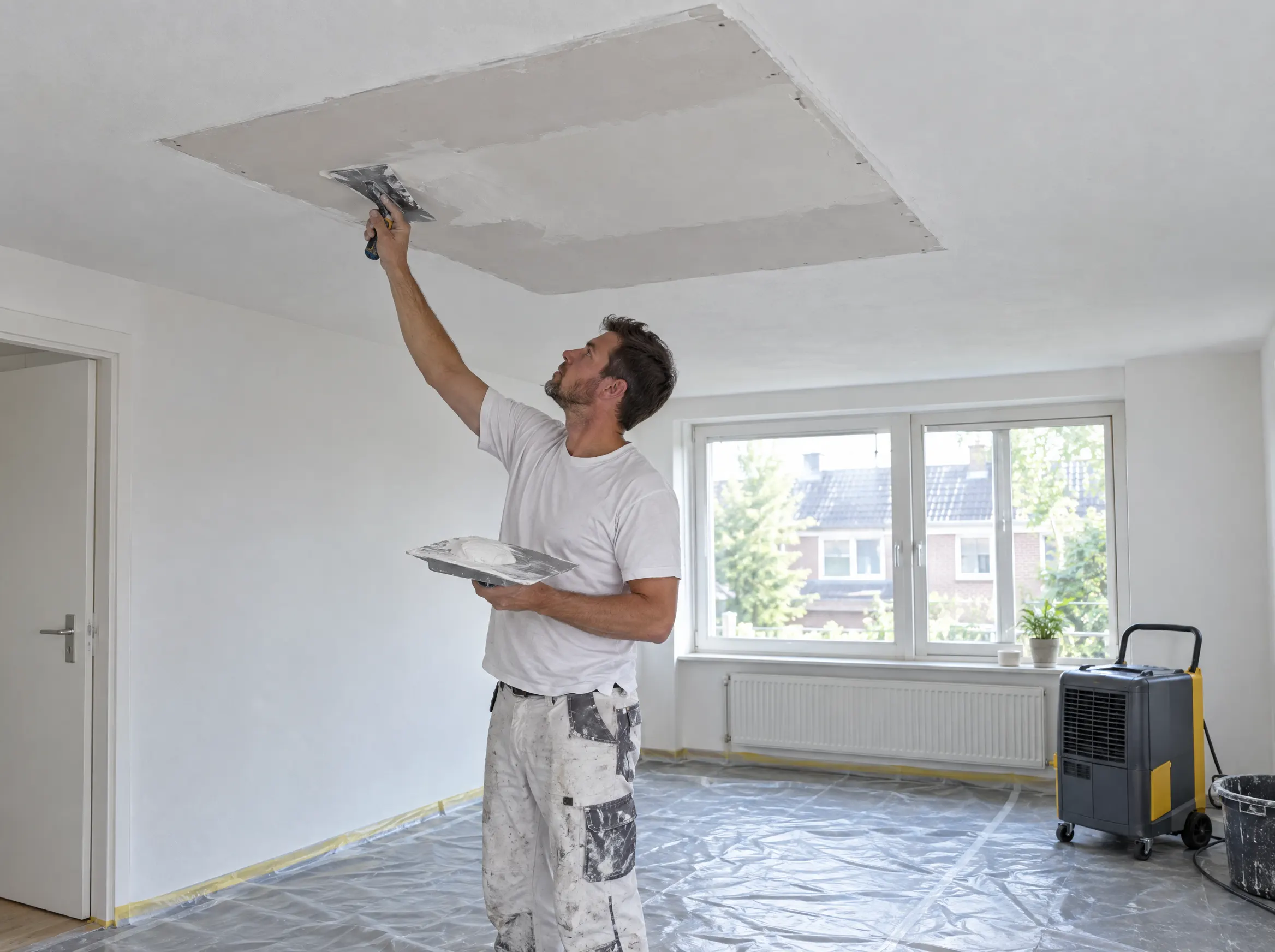
How long does the ceiling need to dry?
That depends on how much water soaked into the ceiling, and you can't see that from the surface. A ceiling can feel dry while the core is still wet. That is why the moisture should always be measured before the work starts. Ventilate well and heat normally; a dehumidifier aimed straight at the ceiling can cause small cracks.
If it needs replastering, the new plaster also needs time to dry before paint or latex can go on. As a rule of thumb, gypsum plaster dries about 1 millimetre of thickness per day.
Brown stains: seal first, then paint
A water stain is usually yellow or brown. The colour comes from the water that soaked through the ceiling, and it dissolves into ordinary wall paint. Paint straight over it and the stain bleeds through again within days, even after two coats.
So the mark first gets a stain-blocking primer. That locks the discolouration in. Then the whole ceiling is painted or sprayed, not just the patch. A patch painted on its own always shows in raking light as a spot with a different sheen.
Replaster or just repaint?
The difference is in the surface underneath. If the plaster is still hard and flat once dry, sealing and repainting is enough. If it is damaged, the bad part has to come off first.
- Just a ring, plaster hard and flat: seal and paint or spray the ceiling
- Plaster soft, crumbly or blistered: remove loose parts, replaster, let it dry, then finish
- Plasterboard sagging or come loose: replace or refix the board, then plaster
- Mould on the ceiling: tackle the cause and the damp first, then repair
What does water damage ceiling repair cost?
The guide prices include 9% VAT. Plastering costs €20 to €28 per m², rolled paint €14 to €19 per m² and spray painting with latex €10 to €14 per m², each with priming and covering up included. Ceilings are at the top of the range. Below 30 m² there is a minimum of €300 per job.
Example 1: a bedroom ceiling of 12 m² with a water stain, plaster still sound. Sealing and painting the whole ceiling is 12 m² times €14 to €19, so €168 to €228. That is below the minimum, so you pay €300.
Example 2: a living room ceiling of 30 m² where the plaster has gone soft. Replastering is 30 m² times €20 to €28, so €600 to €840. Spray painting afterwards is 30 m² times €10 to €14, so €300 to €420. Together €900 to €1,260. If demolition or new plasterboard is needed, you see that in the quote beforehand.
If the home is less than 2 years old, 21% VAT applies instead of 9%.
Will insurance pay for the ceiling?
That depends on the cause and on your policy. According to the Consumentenbond, buildings insurance (opstalverzekering) covers damage to anything fixed in and to your home, including pipes and the bathroom. A ceiling is part of that. Contents insurance (inboedelverzekering) is for your belongings and, according to the government-backed site Wijzer in geldzaken, covers damage from a leak, for example.
Insurance only covers sudden and unexpected damage. Damage that builds up slowly over the years is not covered. According to the financial complaints institute Kifid, policies often contain exclusions such as poor maintenance or building work, and the policy terms decide. For a leaking pipe, the Consumentenbond says all buildings insurers cover the cost of opening up walls or floors to reach the pipe.
If you rent, the landlord usually takes out the buildings insurance. If you bought a flat, it usually runs through the owners' association. If your insurer wants a quote from a tradesperson, you can request one via Spetterloos, in English if you like.
Renting? The leak is your landlord's job
According to the Dutch Legal Aid Desk (Juridisch Loket), a leak counts as a defect and your landlord is responsible for fixing it. In an emergency, such as a leak, the landlord usually has to arrange a solution or temporary fix quickly. If you caused the leak yourself, you have to pay for it.
Report it straight away, by phone and in writing. If you don't report a defect, or report it late, you can be liable for the damage that follows. For damage to your own belongings, look at your contents insurance first; according to the rent tribunal (Huurcommissie), only a court can decide on compensation.
If the landlord doesn't repair it in time, Dutch law lets you have the defect fixed yourself and recover reasonable costs from the landlord. The Juridisch Loket advises doing that only after reporting it in writing with a reasonable deadline, and getting advice first.
Quick help after water damage
Send a few photos, the size of the ceiling in m² and what happened. Within 24 hours you hear what is possible and when. You can write to us in English. The repair only starts once the leak is fixed and the ceiling is dry enough, and the floor and your things are covered first.
Sources
- Consumentenbond, Woonverzekering: dekking waterschade (Dutch), checked 08-10-2026
- Consumentenbond, Wat dekt een opstalverzekering? (Dutch), checked 08-10-2026
- Wijzer in geldzaken, Woonhuis en inboedelverzekering (Dutch), checked 08-10-2026
- Kifid, De verzekeraar wil mijn waterschade niet vergoeden (Dutch), checked 08-10-2026
- Juridisch Loket, Wat kan ik doen bij gebreken aan mijn huurwoning? (Dutch), checked 08-10-2026
- Huurcommissie, Onderhoud en gebreken aan uw woning (Dutch), checked 08-10-2026
- Dutch Civil Code Book 7, article 206 (Dutch), checked 08-10-2026
Also asked
How much does water damage ceiling repair cost?
At least €300 including VAT below 30 m² (guide price). Sealing and repainting is €14 to €19 per m², replastering €20 to €28 per m² and spray painting afterwards €10 to €14 per m².
How do you get brown water stains off a ceiling?
The ceiling has to be dry first. Then put a stain-blocking primer on the mark and repaint the whole ceiling. Ordinary wall paint on its own won't stop the stain coming back through.
Does home insurance cover water damage to my ceiling?
Often, when the damage is sudden and unexpected, such as a burst pipe. The ceiling falls under buildings insurance. Damage that built up slowly and poor maintenance are usually excluded. Report it before you have it repaired.
Who pays for a water damaged ceiling in a rented flat?
A leak is a defect and, according to the Juridisch Loket, the landlord's responsibility, unless you caused it yourself. Report it straight away, also in writing.
How long does plaster take to dry after a leak?
It differs per leak and you can't tell from the surface. Measure the moisture before repairing. If the ceiling is replastered, allow drying time for the new plaster too: about 1 mm per day.
Can I send my request in English?
Yes. You can write to us in English, and all prices on this site include VAT.